
Capability field guide

Tools for control, not theater.

Tempered helps you find performance friction, decide what deserves attention, and keep a return path. Nothing here depends on a red warning badge or an invented health score.

Read the field guide
MODULE INDEX6 MODULES
01Advisor 02Dashboard 03Processes 04Scans 05Undo Center 06Task Manager
Changes require approval
01

Ask in plain language

Advisor

A direct answer, tied to the machine in front of you.

Describe what feels slow. Tempered reads the relevant signals, explains the likely cause, and proposes a reviewable next step — without pretending every symptom needs a tweak.

  • Uses live readings and Windows state
  • Separates observation from recommendation
  • Never applies a change from chat alone
Illustrative UI pattern — not a reading from your PC Why does startup drag? Observed · Reviewable
02

See the actual load

Dashboard

The readings that matter, without a health score.

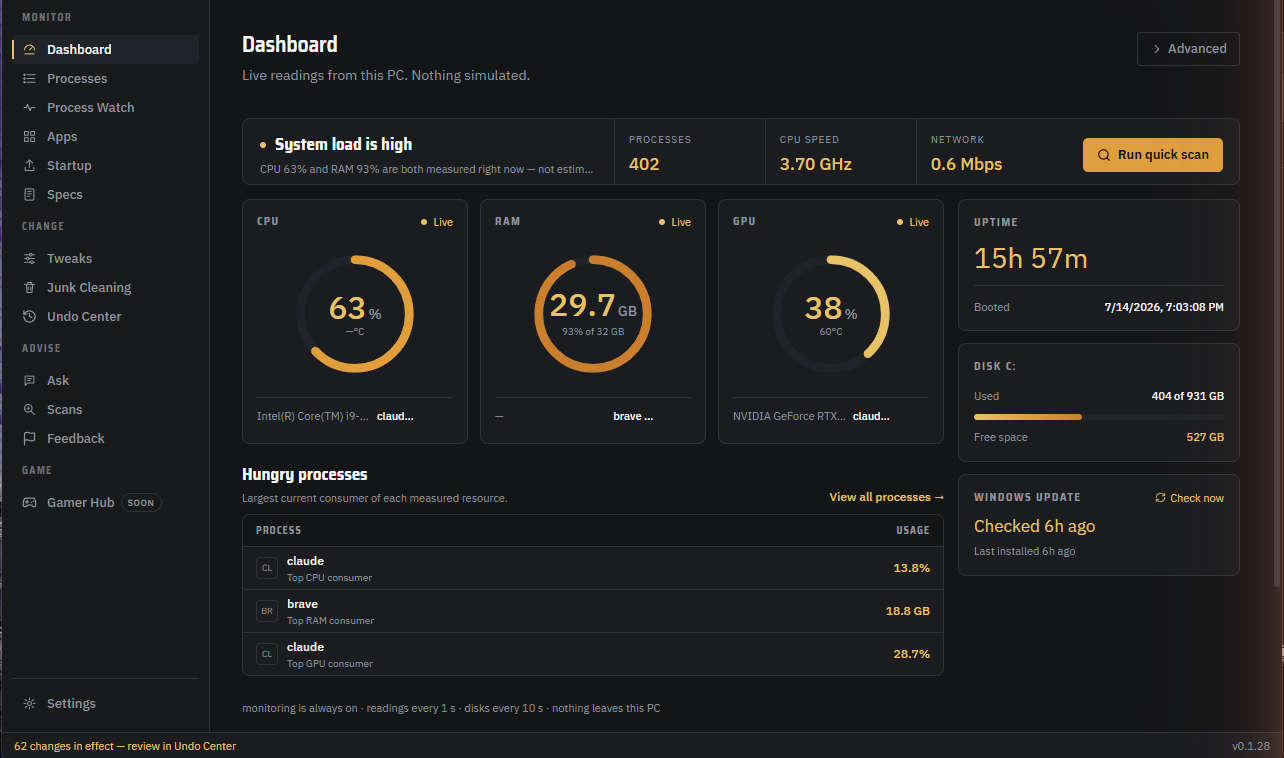
CPU, memory, GPU, disk, uptime, temperatures, and the processes behind the load are presented as measurements — not a vague percentage designed to manufacture urgency.

  • Live hardware readings
  • Before-and-after deltas
  • No invented issue count
Illustrative UI pattern — not a reading from your PC 4.6 GB working set Observed · Reviewable
03

Control what is running

Processes

Understand a process before you suspend it.

Tempered classifies running applications, shows their resource cost, and identifies safe background candidates. Game Mode narrows the field without deleting services or stripping Windows apart.

  • Plain-language process descriptions
  • Safe suspend and restore paths
  • No blind service disabling
Illustrative UI pattern — not a reading from your PC −18% background load Observed · Reviewable
04

Inspect before acting

Scans

Focused checks for startup, storage, and settings.

Scans look for explainable performance friction: heavy startup items, avoidable storage pressure, and Windows settings that conflict with the way the PC is used.

  • Findings grouped by impact
  • Every result names what it touches
  • Registry cleaning is not a feature
Illustrative UI pattern — not a reading from your PC 6 reviewable findings Observed · Reviewable
05

Keep the return path

Undo Center

Every approved change leaves a record and a way back.

The Undo Center records what changed, when it changed, and why. Restore an individual setting instead of trying to remember which optimizer modified the machine.

  • Change history with reasons
  • Individual restore controls
  • No silent batch mutation
Illustrative UI pattern — not a reading from your PC 12 restore points ready Observed · Reviewable
06

See what Windows hides

Task Manager

A full task manager in its own window, with its own judgment.

Task Manager (Tempered), included with Torque, opens as its own app — taskbar icon, desktop shortcut — with per-process detail Windows' own tool doesn't show, a Performance pane for every real disk, adapter, and GPU, and an AI assistant that sees exactly what the window shows. Its security scan researches every background process, monitoring software included, and names what it finds.

  • Wait-chain analysis, affinity, every detail column
  • Its own Ask assistant and its own scans
  • Findings offer guarded one-click actions
Measured on the development bench, not your PC Process table read in ~20 ms Measured · Torque

Readings beside the recommendation.

The dashboard keeps the proposed action in context. You can see the active load, the process behind it, and the expected change before approving anything.

Live readingsNot a synthetic score
Review queueNothing runs silently
Undo stateReturn path recorded
TEMPERED / DASHBOARD MEASURED STATE
Screenshot of the Tempered dashboard showing live Windows performance readings
Suggestion 3 startup items deserve review

From observation to undo.

A recommendation is not permission. Tempered keeps those steps separate and records the result.

01

Observe

Read the current state before naming a fix.

02

Explain

Show the evidence, expected effect, and boundary.

03

Approve

Wait for a clear decision from the user.

04

Measure

Compare the relevant reading after the change.

05

Revert

Keep the original state available in the Undo Center.

Put the machine back under your control.

Early access is rolling out in small batches. We will only email you when it is your turn.